Wednesday, November 13, 2013

Casati Laser " La Speciale " steel frameset

Click here for more photos on Picasa!
A beautiful italian steel frame, Casati Laser " La Speciale " with some extras: hidden cable routing and seatpost binding. If you would like to have one, contact me at velossimo.hu@gmail.com.

A little Casati history / info

 The following info comes from two advertising supplements included with Velonews and Inside Triathlon, from 1996 and 1997:

- Gian Luigi Casati began working for his father Pietro in the shop when he was ten. At the time of writing (1996) Gian Luigi had spent 53 years working in the shop, so it appears he began around 1943. Unfortunately, it does not state when his papa began his torching career. However, in the 1997 article (which would've been Gian Luigi's 54th year) it's stated the company was 75 years old; my admittedly questionable math skills puts the genesis around 1925 or so.

- As of 1996, Casati was producing around 1250 frames per year, 90% of which were custom fitted to clients. The frames were available from sizes 49cm to 70cm, even offered in half-sizes.

- Conceived a completely internal cable routing system in 1995 - even the seat binder bolt, similar to the old Legnano design, but much more refined.

- In 1997 his sons Massimo and Luca were being groomed to continue the business. It's my guess they are probably running the show today.

- Casati acknowledges there is no way they could afford to sponsor a major professional team, however, he did sponsor Gianni Bugno back in his amateur days due to a "strong sense of municipal pride". Bugno hailed from the Monza area.

- His shop team numbered exactly 7, including himself, in 1996. Amazingly enough, the customer turnaround time was stated as four to six weeks for a U.S. delivery, start to finish.

- Gian Luigi's personal credo seems to have been "form follows function". Even in the heyday of fades and graphics, he preferred single color paint schemes to accentuate the details in the workmanship of the metal underneath.


Tuesday, November 12, 2013

Cinelli Supercorsa Columbus SLX steel frameset in "Ferrari rosso" color

Click here for more photos on Picasa!


Cinelli History
(from Wikipedia)

Cinelli was founded in 1948 by Cino Cinelli (born Montespertoli, Italy, 9 February 1916, died 20 April 2001), a former professional road racer and president of the Italian Cyclists' Association. He was a professional racer from 1937 to 1944, winning Milan – San Remo in 1943, the Giro di Lombardia in 1938, and the Tour of the Apennines in 1937.[1] He started a company under his name in 1948.
Cinelli was the seventh of 10 children, the son of a small landowner near Florence.[2] He became interested in bicycle technology after mechanical failures in races. Failure to interest manufacturers with his ideas in 1946 led him to start his own company. His brother Giotto was making steel stems and bars in Florence and Cinelli moved the business to Milan, centre of the Italian cycling industry. He made stems, bars and frames but depended on wholesaling for other companies. By his retirement, Cinelli's own goods were half the business. Stems and bars were 80 per cent of Cinelli's own sales.
Cinelli moved to alloy production in 1963, later than other manufacturers because he was concerned about strength.[2] Annual production of alloy stems and bars rose from 5,000 in the 1950s, to 7,500 in the early 1960s. By 1978 the figure was 150,000. He made no more than 700 frames a year. In 1974, he designed an aerodynamic bike on which Ole Ritter broke his own hour record. The staple product was the Super Corsa road model made from 1947.

Columbus SLX tubeset

"Superbutted" tube set specially designed for professional cyclists, featuring five spirals for greater rigidity in the joint area or the bottom bracket.
Double-butted tube ends. Cyclex Steel.


Monday, November 11, 2013

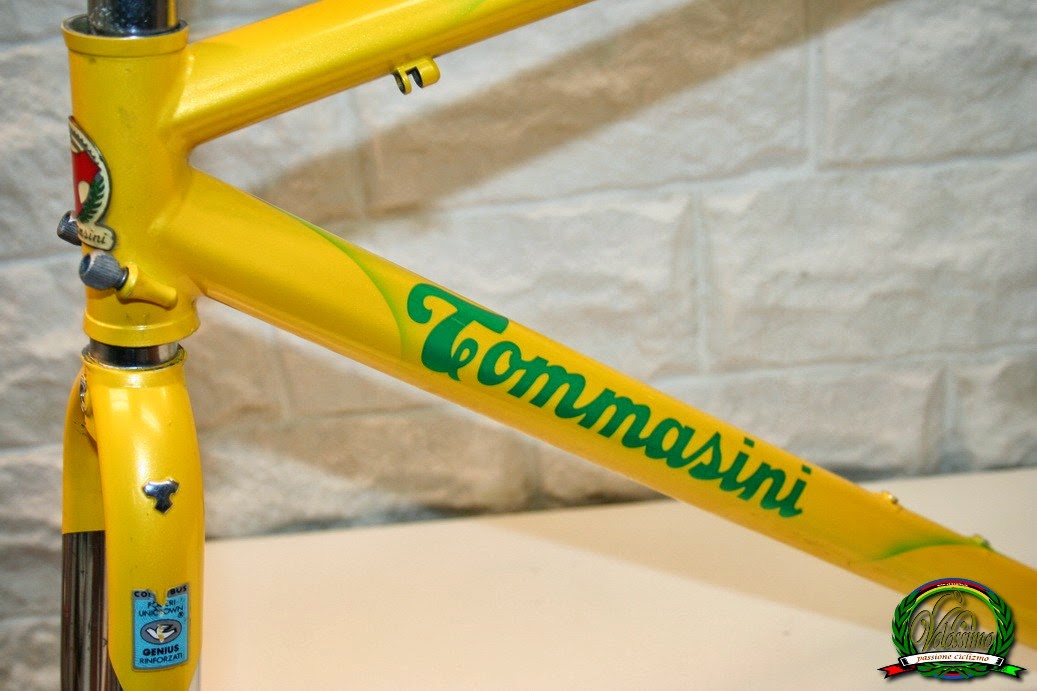
Tommasini Tecno Extra Columbus Nemo / Genius frameset

Click here for more photos on Picasa!
A beautiful italian Tommasini frameset for today, made of Columbus Nemo and Genius tubes, incredible paintjob and colors!

Tommasini has been producing and selling racing bikes since the Second World War. The essence of Tommasini is steeped in history, experience and technical know-how. The continuous research into better ways of building racing bikes has put Tommasini at the forefront of the market.

The entire Tommasini range is hand crafted by highly skilled technicians in the factory at Grosseto Tuscany. Since the introduction of carbon fibre as the base material Tommasini has with its continuous research and development produced a racing bike that not only is lightweight but gives a comfort ride that is unique.

Since its origin the company policy has been one of quality, this is made possible by the use of premium materials combined with innovative technology. The attention to detail by our master craftsmen brings a PASSON and STYLE that is easily recognized by our customers.


Sunday, November 10, 2013

Bianchi Columbus Genius tubing frameset

Click here for more photos!


A light and beautiful italian frameset.

Columbus Genius tubeset

In 1991 Columbus introduced a new steel tubeset, the steel was called Nivacrom and the first tubing made from it was named GENIUS. GENIUS also used Differential Butted Shape butts (DBS) a new features in tubesets in which the shape of the butt actually follows the area of the tube where most of the stress is. It comes in a different shape on different places on the tubes. Columbus made butted ends on GENIUS shorter, so the whole set was the first one strictly designed for TiG welding. A wide selection of tube thicknesses and diameters allowed GENIUS tubing to be used in many different types of frame types.


Friday, November 8, 2013

Pogliaghi "wet white" steel frame sets

Click here for more photos on Picasa!

A real italian masterpiece: oversized tubes, custom made lugs, s-bend rear triangle, beautiful paint and craftmanship! A real legend!


Specification

    * MANESMANN cro-moly tubes
    * Pre-heated tubes, low temperature brazing.
    * Custom traditional geometry – all sizes available in the web page.
    * TOP TUBE diameter 31.8 - triple butted – thickness 0.9/0.6/0.9
    * DOWN TUBE diameter 34.9 - triple butted – thickness 0.9/0.6/0.9
    * SEAT TUBE diameter 31.8 - triple butted – thickness 0.9/0.6/0.9
    * CHAIN STAY diameter 22.2 - triple butted – thickness 0.9/0.6/0.9
    * SEAT STAY diameter 14 - straight gauge 0.8
    * FORK BLADES 28 x 20 - double butted – thickness 0.6/0.8
    * BSA BB – English threaded
    * Seat post diameter required: 30mm
    * Fork Microtech cro-moly 1” threaded – headset required: 1” threaded.

Frames are available to order from stock or from production! Contact at velossimo.hu@gmail.com

History
(Taken from the Custom Bicycle by Denise de la Rosa and Michael Kolin)


Sante Pogliaghi
Via C. Cesariano II, Milano 20154, Italia


In the central section of Milan you will find the small frame-building shop of Sante Pogliaghi located near the Arco della Pace, a neo-classic arch similar in design to the Arc de Triomphe in Paris. Within walking distance is another Milanese landmark, the Castello Sforzesco. Many works of art are displayed in the castle, the most renowned being Michelangelo's Pieta. Amid all this history is a small unobtrusive shop whose address is Via C. Cesariano 11, but whose entrance faces Vaile Bryon indicated by the "Pogliaghi" painted above the door.

Sante Pogliaghi has probably been building bicycle frames longer than any other master builder. He is 62 years old and he started building when he was 11! He worked with his Uncle Brambilla, a famous frame builder of the 1920s. When his uncle died in 1947, Sante Pogliaghi continued building frames but now they appear with the Pogliaghi label. 

Pogliaghi builds primarily road and track racing frames. His specialty, however, is the competition tandem. The lugs on the Pogliaghi tandem are hand made by Pogliaghi himself. Since Columbus builds custom large-diameter tandem tubes for Pogliaghi, he is unable to use standard lugs since no one makes tandem lugs that meet his exacting specifications. Consequently ,he makes them himself.

Pogliaghi has built a few touring frames and touring tandems, but these are not his specialty. He is much more familiar with the technical requirements for racing than he is for touring. Today, Pogliaghi frames are famous throughout the world. Just a few years ago, this little shop built l00 to 120 frames per year. Now it produces about 800 to 900 frames in the same period. There are six builders, including Pogliaghi, and each builder works on a frame from start to finish.

The frames are all hand-brazed without the use of jigs. To help keep the frame from moving, the joints are pinned. Pogliaghi does have a frame jig which he employs when he is building a lot of frames of the same dimensions, but he generally likes to work without a jig. He feels that since he has built frames for 50 years, he can build accurately without a jig. He also feels that when a jig is holding the tubes, the frame will have heat-induced stresses that can result in distortion after cooling.

Contrary to normal practice, he builds a frame by joining the seat tube to the bottom bracket and then the seat tube to the top tube. When he finishes this, he attaches the down tube to the bottom bracket and finishes the main triangle by attaching the head tube.

For the individual framesets, Pogliaghi brazes with what he terms "the natural gas, the cooking one." He also uses propane gas, but only for the larger-diameter tubed tandems. He prefers natural gas because it has 10 percent carbonics. "And so the tube, when heated, loses 10 percent carbonics, but by using the natural gas you only lose 5 percent." Pogliaghi uses a Swiss product called Castolin to braze his frames. It is, according to Pogliaghi, a type of bronze rod. But it actually has a silver content of about 40 percent. Pogliaghi has tried using brazing materials with higher silver content but finds that they are too liquid to efficiently complement his building techniques. He is satisfied with the results achieved by using Castolin since Castolin has high fluidity, a low brazing temperature, and good brazing resistance.

Pogliaghi does not design a frame to meet specific angles. He is more concerned with the length of the top tube in proportion to the seat tube. As a general rule of thumb, Pogliaghi will build a bicycle with a top tube only 2 CM larger or smaller than the seat tube. Otherwise, the bicycle will be ill proportioned and will not ride correctly. For example, if you order a 58 CM. Pogliaghi, the top tube from the center of the head lug to the center of the seat lug, can vary from 56 to 60 CM depending on your individual needs. However, this rule only applies to the medium-size frames. The small and the large frames will not follow this rule. For example, the smallest top tube Pogliaghi will put on a 47 CM. frame is 49 CM.

Pogliaghi does not use cast lugs or cast bottom brackets on his frames. He thinks that they create a frame that is too rigid and, as a result, prone to tube breakage at the joints. He does, however, use a cast fork crown, because he feels that the fork must be stiff in order to provide good handling. He generally builds with Columbus tubing, but he will build with Ishiwata or Reynolds tubes, depending on what the customer wants.

All Sante Pogliaghi's frames are sent out for painting and chroming. Sante Pogliaghi, however, cautions about chroming. He believes the chroming should not be done in a sulfuric acid base, otherwise it will eat away at the tube and eventually crack it. A word of advice from Pogliaghi if you must have your frame chromed: "Oil the inside of the frame after it has been chromed" to prevent rust.


In Italy, and especially in Milan, Pogliaghi is called the master tailor of the bicycle." He has custom-fitted frames for many world-class -riders like Sercu, Merckx, Fagin, as well as Italian champions like Baghetto, Nunzi, and Rossi. If you would like Pogliaghi to build a frame, you had better give him your order soon as he plans to retire by 1980. The process is somewhat difficult since Pogliaghi only speaks Italian. We recommend that you order a frame through one of the many bicycle stores throughout the United States that deal directly with Pogliaghi. Because of his ability to custom-design a frame to an individual rider's physique and racing specialty, there is a long waiting list for a Pogliaghi custom frame.


Tuesday, November 5, 2013

Casati Gold Line S ( Line d'Oro ) Columbus SLX frame set

Click for more photos!

A beautiful italian frameset with exclusive solutions on it, check out the detailed picasa photo album!


A little Casati history / info

 The following info comes from two advertising supplements included with Velonews and Inside Triathlon, from 1996 and 1997:

- Gian Luigi Casati began working for his father Pietro in the shop when he was ten. At the time of writing (1996) Gian Luigi had spent 53 years working in the shop, so it appears he began around 1943. Unfortunately, it does not state when his papa began his torching career. However, in the 1997 article (which would've been Gian Luigi's 54th year) it's stated the company was 75 years old; my admittedly questionable math skills puts the genesis around 1925 or so.

- As of 1996, Casati was producing around 1250 frames per year, 90% of which were custom fitted to clients. The frames were available from sizes 49cm to 70cm, even offered in half-sizes.

- Conceived a completely internal cable routing system in 1995 - even the seat binder bolt, similar to the old Legnano design, but much more refined.

- In 1997 his sons Massimo and Luca were being groomed to continue the business. It's my guess they are probably running the show today.

- Casati acknowledges there is no way they could afford to sponsor a major professional team, however, he did sponsor Gianni Bugno back in his amateur days due to a "strong sense of municipal pride". Bugno hailed from the Monza area.

- His shop team numbered exactly 7, including himself, in 1996. Amazingly enough, the customer turnaround time was stated as four to six weeks for a U.S. delivery, start to finish.

- Gian Luigi's personal credo seems to have been "form follows function". Even in the heyday of fades and graphics, he preferred single color paint schemes to accentuate the details in the workmanship of the metal underneath.